
Cloud auditing with Myrmex: from raw findings to fixes in plain language
The cloud no longer has a perimeter. Every account, every identity and every short-lived resource is a surface that keeps changing, and auditing all of it by hand doesn't add up. In Myrmex, that heavy lifting happens underneath the screen: the Myrmex agent collects the posture of every account, Athena turns the volume into a queue of real risk, and Hydra Cloud runs the fix side by side with you. And when a risk is too big to pass in silence, Myrmex won't let you move on without signing.
The problem isn't a lack of data, it's too much of it
Auditing a cloud was never about finding information. It's the opposite: configuration, inventory, identities, CVEs, baseline drift, controls that pass and controls that fail, spread across accounts, regions and services that come and go all the time. Whoever audits drowns before finishing.
Most tools answer that with more screens. Myrmex starts from a different principle: the people operating shouldn't get raw data, they should get the result. The screen is the visible part, but it isn't where the work happens.
What presents isn't what audits
Myrmex splits the work into layers, each with a clear role. The platform presents: it's where you see posture, browse controls, open a finding and follow the fix. Underneath it, three layers do the work.
Collection: the Myrmex agent in collector mode. No audit is worth more than the data behind it. The Myrmex agent, installed in your environment and running in collector mode, audits the cloud directly through the AWS, Azure, Google Cloud, OCI and Microsoft 365 APIs and measures the real state of every resource, not the state someone declared in a spreadsheet. Scans are scheduled, every 24 hours by default and configurable from 1 hour to 7 days, and you can run one on the spot whenever you need. The connection is outbound only, and credentials stay in Myrmex.
Analysis: Athena. Collected data isn't an answer yet. Athena takes the findings from every integration, cloud, on-premises and hosts, and does what an experienced auditor would:
- Correlates. A control that fails in one account may be neutralized by another that passes somewhere else. Athena looks at the whole, not the isolated finding.
- Separates real risk from noise. Every critical or high finding gets a verdict, and the default is to treat it as real risk until there is evidence otherwise. When needed, Athena asks a specialist for a live, read-only check.
- Prioritizes by business impact. The queue runs from P0 to P3 by impact: internet exposure, data sensitivity, blast radius and ease of exploitation, not by the control's severity alone.
- Hides nothing. Noise gets out of the way, but every critical or high finding of real risk stays in the queue. And lowering a finding's priority is only a proposal until someone approves it.
The result is a queue of what to fix first and an executive summary of your posture, ready for whoever decides.
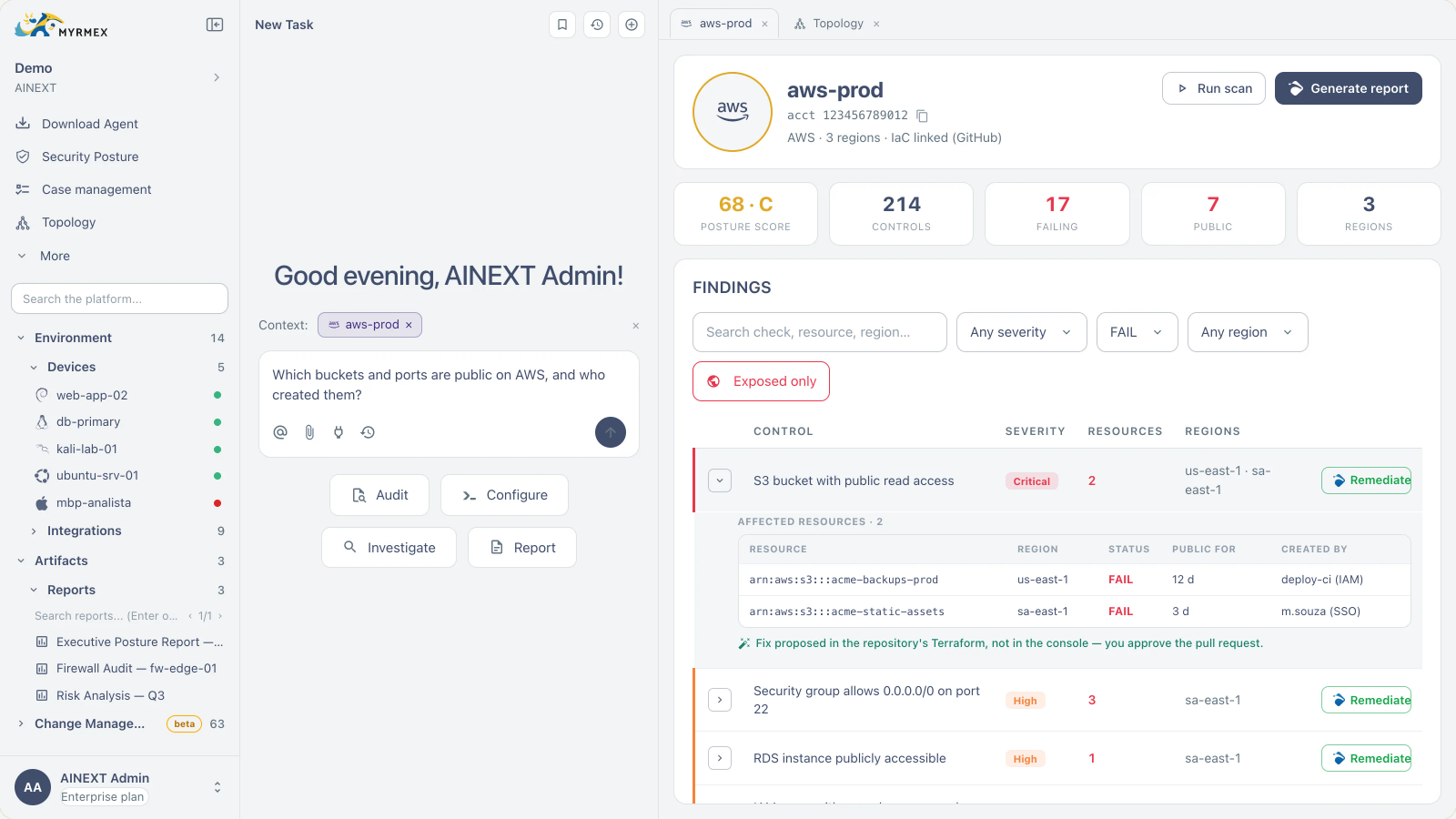
The fix: Hydra Cloud, with you in charge. Finding the problem is only the beginning. From the Remediate button or a request in the chat, Hydra Cloud, the cloud specialist, builds the fix plan. Reading needs no approval; changing does. The fix ships the way your team works: through the provider's CLI, as a pull request in your infrastructure-as-code repository, or as a change request that only a human approves. Myrmex does the work, but never behind your back.
What you get
- Posture per account and per framework. CIS Benchmarks for each provider and, on AWS, frameworks such as ISO 27001:2022, NIST 800-53, NIST CSF, PCI DSS, SOC 2, HIPAA and GDPR, among others.
- Actionable findings. Control, severity, affected resources and region for every failure.
- A P0 to P3 priority queue, with the reasoning behind each item and an executive summary from Athena.
- A guided fix, through CLI, an IaC pull request or a change request, always with your approval before any change.
- Reports ready for internal audit, the committee or the board.
The risk letter: when Myrmex won't let it pass in silence
Every audit reaches a point where someone wants to silence a finding. For most items, that's fine. But when the finding is critical or high and hasn't been approved as noise, Myrmex won't let it go with a click: it requires a risk acceptance letter.
It isn't bureaucracy. It's the recognition that some decisions carry weight and need an owner. The letter turns an impulsive click into a conscious, recorded choice:
- It is truly mandatory. The rule is enforced on the server: without the letter, the finding isn't silenced, and marking it as a false positive doesn't get around it.
- It expires. The acceptance lasts 90 days. After that, the finding comes back and the decision has to be made again.
- It has more than one owner when the risk is critical. Critical findings require a second approver.
- It is really signed. Each signer signs with a one-time code (OTP), and the document carries a SHA-256 integrity seal and an audit trail.
- It only counts once signed. The finding stays active until every signature is collected. If someone declines, it stays active.
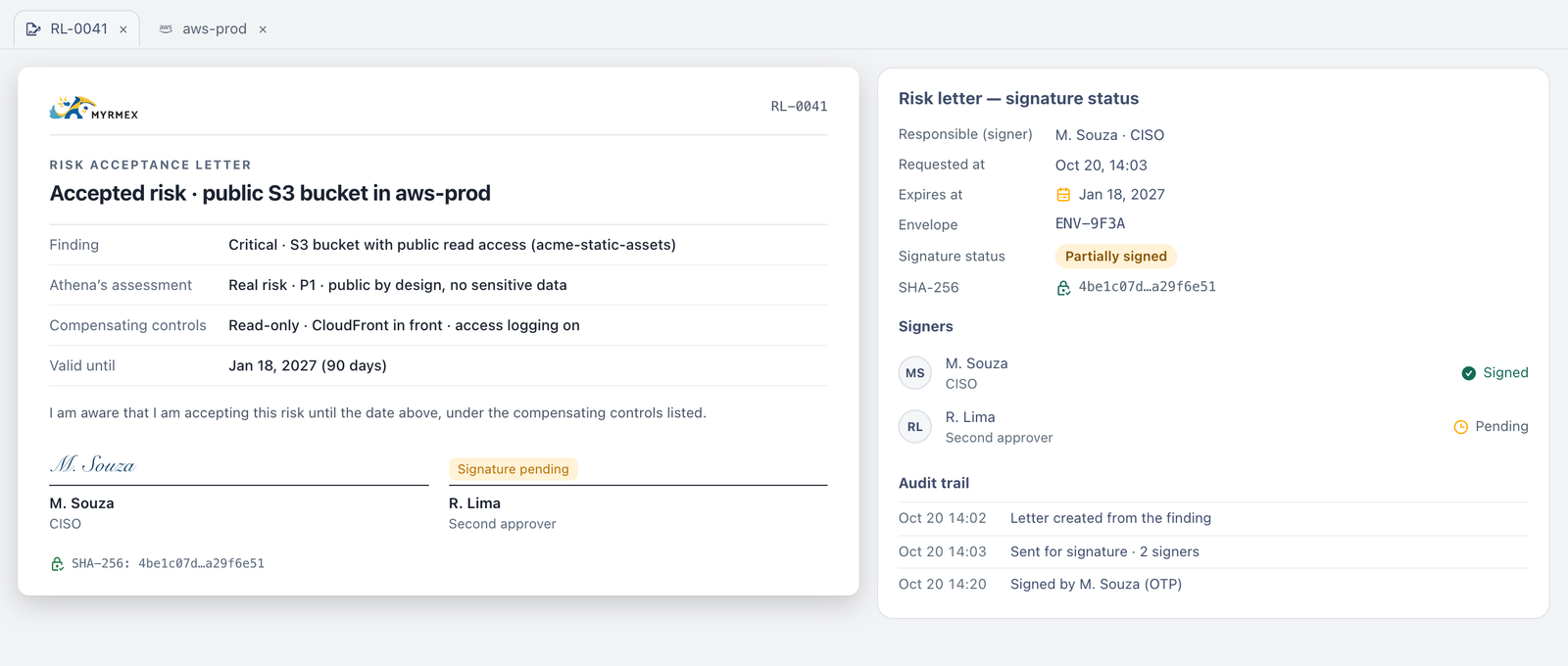
That's how Myrmex behaves less like software that obeys and more like someone who takes part in the decision. It doesn't just show the risk: it insists that someone, by name, faces it.
How to get started
- Install the Myrmex agent and turn on collector mode for the cloud.
- Connect your cloud account (AWS, Azure, Google Cloud, OCI or Microsoft 365). Credentials go straight to Myrmex; the AI agent only receives the integration.
- Set the audit cadence, or run the first scan right away.
- Ask Athena for the priority queue and start with P0.
Try Myrmex or talk to our team.
What comes next
We're at the start of this road. The next steps:
- Improvements to patch management, to close the loop between the vulnerability found and the fix applied.
- A new live voice conversation agent, to run vulnerability management autonomously.
- Infrastructure-as-code (IaC) auditing, to catch the problem before it reaches the cloud.
- Real-time collaboration between users, so risk analysis is done together, by the people who need to decide.
Auditing the cloud is no longer a race people lose on their own. The agent collects, Athena prioritizes, Hydra Cloud fixes, and when the risk is too big to go unnoticed, Myrmex asks for your signature. You decide. Myrmex executes.